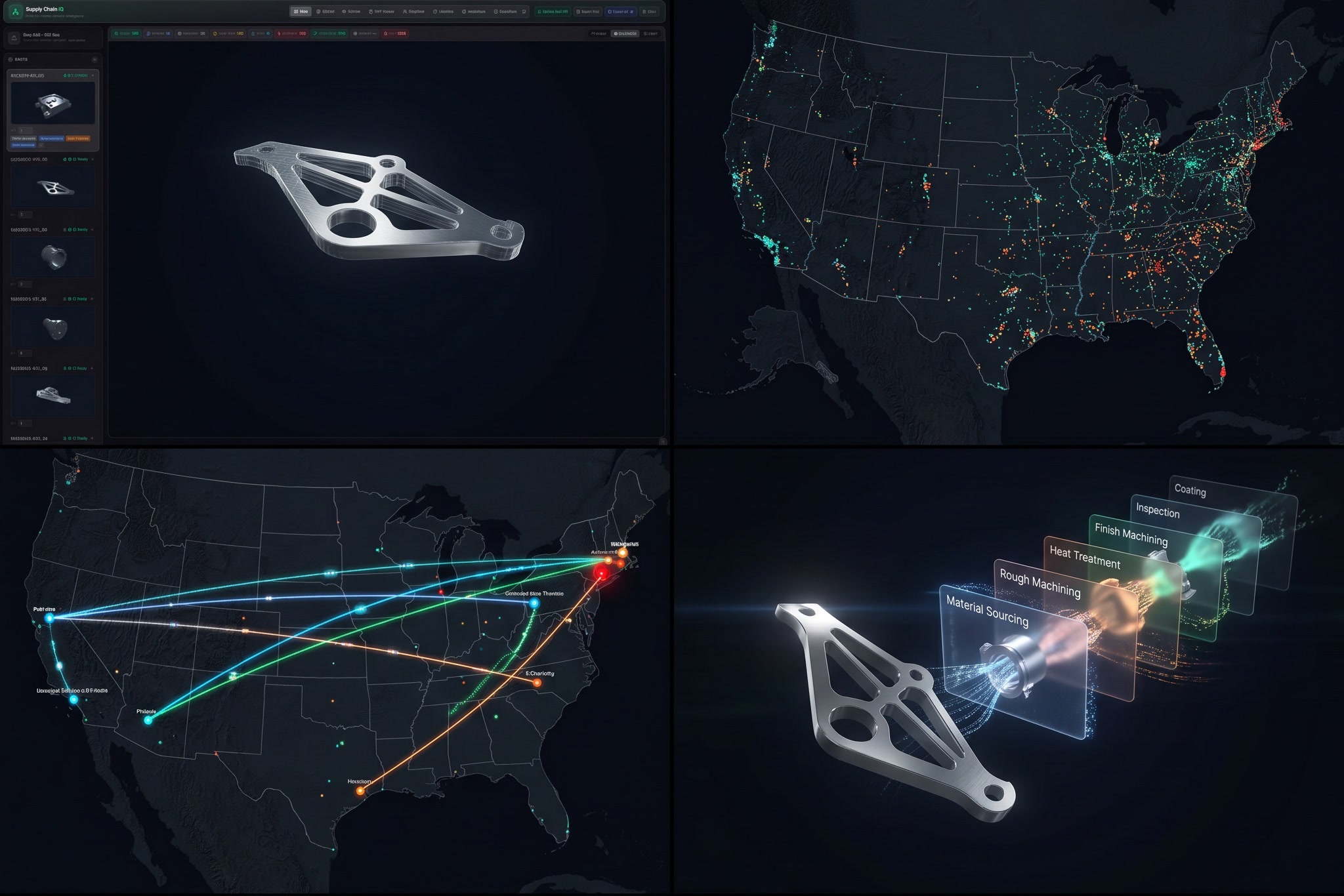
What does industrial-base risk look like in 14 seconds?
Defense primes don’t need another supplier directory.They need a system that wargames the graph.
Industrial-base risk in 14 seconds.
A defense procurement officer at 11pm has a forging holding up an F-35 line. Vendor Command Center turns "find me a 5-axis AS9100 shop in Texas with surge headroom" into a ranked, auditable shortlist in seconds — every match a verified CAGE code, every recommendation explainable to a contracting officer.
Wargame before you commit.
Surge Command V2 ships with 75 hand-authored disruption scenarios — component obsolescence, lithium PRC chokehold, sole-source SRM stress, sub-sea cable sabotage. Each scenario plays against your real supplier graph, not fixtures. Chessmaster's 9-agent adversarial pipeline tells you what the adversary does next.
Real federal data, not pretty charts.
115,016 verified suppliers — sourced from USAspending, SAM.gov, DLA QPL/QML, NADCAP, AS9100D registries. Every CAGE in the candidates column is a real federal-register identifier. Every recommendation is traceable. No scraping, no synthetic data, no decade-old PDF dumps.
The full NADCAP graph.
The only platform with 100% of US NADCAP-accredited facilities — all 2,700+ verified against the authoritative special-process registry, with commodity-level accreditation mapping across all 24 categories, merit status tracking, and certificate expiry monitoring. 3,587 accreditation records; paired with 6,000+ AS9100 aerospace-quality certified suppliers — the only complete federal-aerospace cleared-cert graph in production.
Four engines.
One decision layer.
Each app is a real engine, not a marketing slide. They share a common compliance posture, the same supplier graph, the same 14-second decision contract. Use one or stack all four — Chessmaster is the strategy layer that turns the rest into wargaming.
Mission Control
MCDLA RFI intake → supplier match → readiness forecast. Aggregates RFI line items, surfaces matched suppliers from the verified database, calculates readiness against timeline + quantity + regulatory class. Live on DLA demo system as of May 2026.
- NIIN / FSC enrichment
- AMSC + AMC parser
- Readiness forecast per line
- Cross-program incident view
Vendor Command Center
VCCSub-millisecond intent matching against the verified supplier graph. Multi-attribute facility scoring against your part requirements. Zero external API calls — every match is reproducible and traceable to a federal-register identity.
- CAGE / NSN / NAICS lookups
- Multi-attribute facility scoring
- Regulatory + cert-posture filters
- Foreign-ownership change alerts
Surge Command V2
SURGE75 hand-authored disruption scenarios — component obsolescence, lithium chokehold, sole-source SRM stress, sub-sea cable sabotage. Each plays against your real supplier graph. Executive summary schema delivers decision-grade narrative in ~200 words per scenario.
- 75 active disruption scenarios
- Tier-N traceability
- PRC / foreign-content scoring
- Live supplier-resolution engine
Chessmaster
CMTR9-agent industrial decision layer inside Surge V2. Orchestrator, Constraint, Manufacturing, Supply-Chain, Risk/Adversary, COA-Generator, Adversarial-Sim, Monte-Carlo, Decision-Compression. Produces a Pareto frontier of options + red-team simulation. Strategy, not sourcing.
- 9 specialized agents
- Adversarial red-team simulation
- Monte-Carlo outcome modeling
- Pareto frontier decision compression
SIX THINGS NOBODY ELSE SHIPS
Built for the buyer other tools can’t serve.
Every signature feature below is built and in the product today — not roadmap, not slideware. Air-gap deployable, defense-compliant, indexed against 107K verified suppliers. None of them require an external LLM.
Sealed Drop
ITAR drawings literally cannot leak.
When a buyer drops a CUI / ITAR / EAR drawing, the platform detects the marking client-side BEFORE any network call. Files are parsed locally; the supplier cohort pre-filters to ITAR-registered + US-citizen-owned shops; a tamper-evident audit hash proves the file never crossed a network boundary.
Cloud quoting marketplaces physically cannot ship this — their LLMs live in someone else's cloud.
Living Packet
Sourcing Packets answer their own staleness question.
Every signed Sourcing Packet PDF stays connected to its vendor cohort. When a cert expires, a contract awards, or a sanction signal hits, the packet flags itself as stale and one click regenerates a v2 with a "Changes since v1" diff cover — same SCIQ-SIG hash chain, parent-linked.
Sourcing analysts get asked "is this still accurate?" every Monday — the packet now answers itself.
Cohort Counterfactuals
What you're choosing AGAINST, not just what you asked for.
Below every ranked-result, the agent surfaces three perturbed-filter previews — "Drop AS9100 → +89 shops. Add NADCAP → −41 (only 6 remain). Production-capable only → top 3 holds, ranks 4-8 reshuffle." Possible only because all 107K suppliers are indexed locally and PVSE rank is microseconds-fast.
Off-the-shelf federal-data analytics tools cannot do this. Turns the chat from search box into negotiation partner.
Sourcing Lanes
Industrial reachability, drawn live as you constrain.
The hero globe reacts to every filter the buyer toggles. Non-matching dots dim to 12%; the surviving cohort pops; a faint convex-hull polygon traces the geographic "lane" of capability. Add "AS9100 + Texas + Inconel" → the lane tightens to nine dots with arcs to the buyer's plant. Exportable as a PNG for the procurement memo.
A contracting officer sees their surge-capacity geometry for the first time.
Offline Proof
The Sourcing Packet proves itself on a disconnected machine.
Every exported PDF ships with a companion .sig.json sidecar — a SHA-256 of the rendered bytes plus an HMAC chain over the structural payload. A contracting officer verifies it on an air-gapped SCIF workstation with a standalone Node-builtins CLI: no internet, no npm install. One number edited in Acrobat and verification fails loudly.
Competitors hand you a PDF you have to trust. This one is checkable offline, by them, on their hardware.
Print Reader
A 1989 scanned defense print becomes a vetted supplier cohort.
Drop a flat image-only PDF — the scanned, no-embedded-text drawings DLA holds by the million. Local OCR plus a DSCC / CAGE-aware title-block parser lifts part number, material, and tolerances; the equipment model derives the required machining families; the supplier cohort is matched. Entirely on-prem — no cloud OCR, no external vision model, no LLM.
Every legacy obsolescence part lives as a scanned image. Nobody else reads them without shipping the file to a cloud.
Watch one resolve right now.
Below: a real Surge V2 disruption scenario running against the real supplier database, line by line. Every CAGE in the candidates column is a real federal-register identifier. Verdicts are produced by the actual classification engine, not a recording. The page didn’t need to ask you anything to start.
Built for the program managers who can’t afford a wrong supplier.
Component EOL, NSN going dark, weapon-system sustainment at risk. Surge V2 surfaces qualified alternates with QPL conformance — Clinton at DLA called this "the use case." Hours, not weeks.
Supplier failed mid-program. Activate second source, accept schedule slip, or invoke DPA Title III? Chessmaster runs all three branches against the real industrial-base graph and shows the Pareto frontier.
"Do I have surge for F-35 radar in 90 days before I commit?" Vendor Command Center plus Mission Control’s readiness forecast answer in 14 seconds, not 14 days.
"What does the PLA know about our Sentinel SRM dependency?" Chessmaster's adversarial-sim agent generates red-team responses to your supply graph — what the adversary attacks first, what they exploit second.
Tier-2 supplier just got acquired by a PRC firm. VCC's foreign-ownership change alerts catch it within 24 hours, not at the next compliance audit. Regulatory and cert-posture gates surface immediately.
Export-control cert chain verified for every line item before the RFP response leaves. Mission Control + Compliance-IQ surface the cert chain alongside the bid — no more audit-week scrambles.
Cleared at the surface that matters.
No cloud AI. No external model dependencies. No customer data ever leaves your enclave. The platform’s decision layer is auditable code, not a model someone else trained — and every supplier in the database is a verified federal-register identity.
Supply chain intelligence, explained
What is defense supply chain intelligence?
Supply chain intelligence turns a part or program into a sourced, risk-scored, compliance-aware supply chain — automatically, with decision-grade evidence. For defense and aerospace work, that means matching qualified U.S. suppliers to every manufacturing stage and surfacing the compliance and foreign-ownership risks that stall programs, before they reach a contracting officer.
What is supply chain intelligence?
Supply chain intelligence is the practice of turning a part or program into a sourced, risk-scored, compliance-aware supply chain — automatically and with decision-grade evidence. Instead of manually hunting for suppliers, it identifies who can make each stage of a part, scores them on capability, capacity, lead time, location, and compliance, and surfaces the risks before they reach a contracting officer.
How is defense supply chain intelligence different from commercial?
Defense work adds hard constraints commercial tools ignore: ITAR and export control, CMMC and NIST 800-171 cybersecurity, NADCAP and AS9100 quality accreditation, Buy American Act and DFARS specialty-metals sourcing, and foreign-ownership (FOCI) exposure. Defense supply chain intelligence gates and scores suppliers against these requirements and produces the evidence a program office needs to defend the decision.
What does Tribalogix Supply Chain IQ do?
From a single part, Supply Chain IQ (SCIQ) builds the end-to-end manufacturing route — material, machining, heat treat, finishing, inspection — matches qualified U.S. suppliers to every stage, and scores each on capability fit, capacity, lead time, distance, and compliance. It then surfaces single points of failure, foreign-ownership exposure, and compliance gaps, with a built-in strategy assistant grounded in the real match data.
Which compliance standards does it check?
AS9100, NADCAP, CMMC, ITAR registration, the Buy American Act, and DFARS specialty-metals requirements, among others. Suppliers can be hard-gated on required certifications and soft-scored on preferred ones, so a non-compliant shop never surfaces as a viable pick.
How does it identify supply-chain risk?
Per manufacturing stage, it flags single points of failure (only one qualified source), foreign-ownership (FOCI) exposure, expired or missing certifications, and compliance gaps against the part’s requirements — the failure modes that stall defense and aerospace programs.
Can it run air-gapped or on-premises?
Yes. Supply Chain IQ is engineered to run air-gapped on local AI, so no part data, supplier data, or program information has to leave the operator’s environment — a requirement for compliance-sensitive and classified-adjacent defense work.
Who is supply chain intelligence for?
Defense primes, sub-tier manufacturers, DLA, program managers, and contracting officers who need to source compliant, resilient supply chains for defense and aerospace parts — quickly, and with evidence they can defend.
Tell us what you’re sourcing.
Drop a program brief or a sourcing question. We’ll respond within 14 hours with a 90-second video walking your specific question through Mission Control → VCC → Surge V2 → Chessmaster. No marketing, no demo deck.